PARRC — People-centred Adaptive Reuse for Restorative Cities
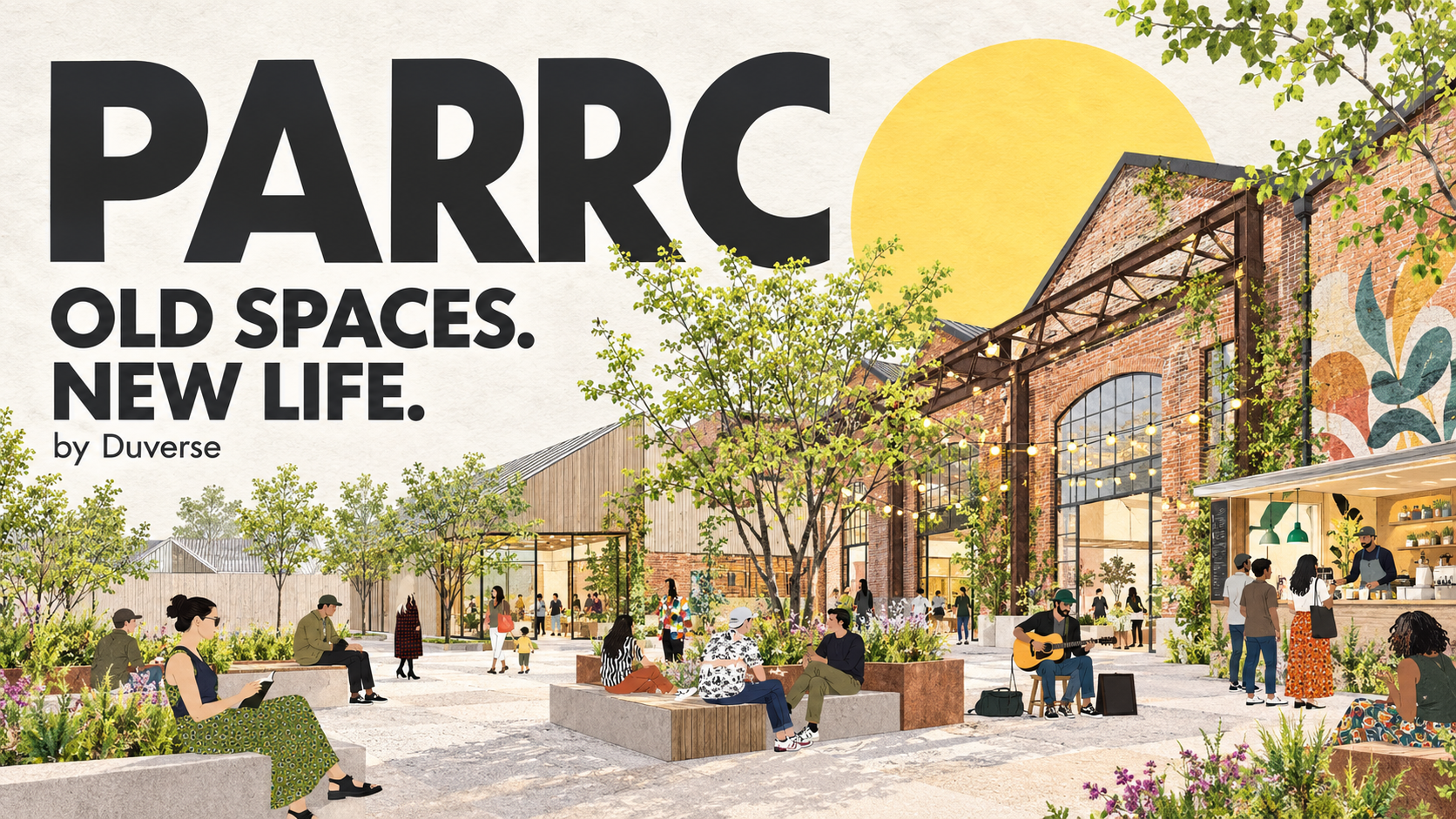
Introducing PARRC: Duverse’s New Methodology for Reimagining Urban Spaces
What if the next breakthrough in your city began with the places you already have?
An underused square. A vacant building. A park that residents rarely visit. A disconnected pedestrian route. These places hold opportunities to improve everyday life, strengthen local economies and create lasting environmental value.
Realising that potential requires understanding the relationship between a place, the people who use it and the wider neighbourhood.
Developed by Duverse, PARRC—People-centred Adaptive Reuse for Restorative Cities—is a new methodology designed to transform how cities assess, redesign and reuse existing urban structures and spaces.
PARRC brings together urban design, community knowledge, insights from psychology and AI-supported analysis. Its ambition is to help decision-makers turn underused places into environments that support wellbeing, connection, activity and local opportunity.
A New Purpose for the Places Around Us
Cities evolve. Buildings lose their original function, neighbourhood needs change, and public spaces can become disconnected from the communities they serve.
Yet these places often retain considerable value: materials that can be reused, memories worth preserving, established connections and opportunities for new activities.
PARRC starts by exploring that existing value.
A vacant building might become a shared creative workspace. An overlooked courtyard could support local food businesses and community gatherings. An underused paved area might accommodate shade, movement, play and quieter places to rest.
The right intervention depends on the place. PARRC is designed to help identify what is appropriate, feasible and meaningful in each context.
Understanding the Community Behind the Space
Every neighbourhood contains knowledge, talent and cultural character that conventional assessments can overlook.
Residents may include artists, musicians, cooks, craftspeople, sports enthusiasts and entrepreneurs. Local groups may already organise activities or maintain informal support networks. Familiar landmarks and gathering places can carry meaning that is difficult to see on a map.
PARRC brings these strengths into the planning conversation.
Community participation helps identify what people value, what prevents them from using a place and what they would like it to become. Local art, authorised graffiti, recipes, music and sporting traditions can help shape new uses and give residents a meaningful role in their development.
The aim is to create places that reflect the people who live there—and give their capabilities room to grow.
Connecting Urban Design With Wellbeing
The experience of a place includes its shade, sound, accessibility, opportunities for movement and possibilities for social connection.
PARRC considers these factors together when exploring how an existing environment could work better for its users.
That might mean improving an accessible walking route, creating opportunities for intergenerational activity, integrating nature, providing comfortable seating or balancing lively gathering spaces with quieter areas.
Mental wellbeing and everyday experience are explicit considerations within the methodology. Proposed benefits are treated as outcomes to assess through appropriate evidence, with attention to differences between user groups.
PARRC also creates a basis for exploring how changes in urban experience relate to everyday functioning and productivity. These relationships require careful measurement rather than assumptions.
Using AI to Support Better Decisions
Urban transformation involves competing needs, limited resources and incomplete information.
PARRC is designed to use AI-assisted analysis and digital planning tools to help organise available information, explore alternatives and support comparison between possible interventions.
This gives public authorities, designers and project stakeholders a clearer basis for discussing questions such as:
- Which existing assets offer the most promising opportunities for reuse?
- How could alternative uses serve different community needs?
- What environmental, social and economic trade-offs should be considered?
- What will each option require to operate and maintain?
- How should results be measured after implementation?
Professional expertise, community participation and accountable human decisions remain central to the process.
Designing for Lasting Value
An attractive design is only one part of a successful place. Its long-term value also depends on affordability, maintenance, management and continued use.
PARRC therefore considers how proposed interventions could be sustained over time. Potential arrangements may involve public authorities, businesses, community organisations and local operators, with responsibilities suited to the project.
Depending on the context, new uses could support cultural programming, shared facilities, small businesses, recreation or local services.
Environmental considerations include retaining useful assets, reducing unnecessary replacement and identifying opportunities to improve resource efficiency. Economic assessment considers delivery and operating costs alongside potential benefits.
The methodology also encourages attention to unintended effects, including whether changes could exclude existing users or make valued activities less affordable.
From Urban Ambition to a Practical Pilot
PARRC is being developed to support municipalities, developers, asset owners and urban regeneration partners seeking a structured approach to people-centred adaptive reuse.
A pilot provides an opportunity to apply the methodology to a defined place, establish a baseline, develop feasible interventions and evaluate the results. Lessons can then inform future decisions and adaptation to other settings.
For organisations considering regeneration, PARRC offers a starting point for connecting physical improvements with community priorities and measurable value.
Explore PARRC With Duverse
Do you manage a public space, building or neighbourhood that could deliver more value for its community?
Duverse welcomes discussions with municipalities, developers, asset owners, research organisations and implementation partners interested in exploring PARRC.
Contact our team to discuss your site, priorities and potential collaboration. We can explore the scope of an initial assessment and what a practical pilot could involve.
Book a PARRC discovery meeting with Duverse.
Bring an existing place. Let’s explore what it could become.